History of the golden age, the fish farmer and farm life
The year is 1862. A little boy is climbing the rocks west of Lykling. He looks out. Is that a large sailing ship he sees far out there? He has to tell his friends. As the boy jumps down from the rock, his clog hits the ground with great force. Something he has never seen before becomes apparent. The boy picks up the small lump. It is gold he has found. A few decades later, there is a Klondike atmosphere at Lykling. Rocks are being drilled and blasted, fantastic sums are being invested, colorful boarding ships are moored at sea, bakeries become hotels, and several hundred people are competing to find gold at Lykling.
The year is 2019. At one of the quartz corridors in the former gold mining area lies Gullvegen Gardstun. One of the most idyllic places in Sunnhordland's most beautiful nature. 155 years since the boy at Lykling by chance found gold, it is on new exciting plans here all the way west of Bømlo. Stories must be told and new ones must be created. But this time it's not the gold that's in the center. It's human. Gold remains as it often is: A small but exclusive part of history.
The Golden Age at Lykling - Norway's biggest gold adventure
"One can hope that in the near future on Bømmeløen, which has until now been considered one of the poorest areas on our West Coast, we will see an enterprise that is unparalleled in this country."
This was written by "Dagbladet" in April 1884. The previous year, a rock was mined in the Storhougen Mine that appeared to contain 1/2 kilo of gold worth 1110 kroner. This sparked boundless optimism, largely spread by sensational reports in "The Times as in Norwegian newspapers". The white quartz gongs that burst out of the gray rock down towards the seashore at Lykling contained larger lumps and veins of gold than the English engineers had seen in the quartz years on the gold fields in California and Australia. With this, Norway's greatest gold adventure began!
It all started in 1862, when a shepherd boy accidentally found the first nugget of gold at Lykling. It took 20 years for the gold rush to break out. From 1882-1910, gold mining was carried out on a large scale along the quartz veins in Lyklingeberga, with several hundred men employed at most and about 200 kilograms of gold being recovered in total. Over the course of two years, over 1,200 finds were reported to the sheriff of Finnås. Three large companies, mainly financed and run by Englishmen, but also a number of “individual enterprises”, turned the small village on its head during the approximately 25 years that the mining lasted. Two hotels, a hotel ship, several bakeries and a number of shops of various kinds were built around the mining operations.
This is a small and brief introduction to history. Gullvegen Gardstun communicates and tells about the "Gold Mining History" that unfolded in Lykling at the end of the 19th century and the beginning of the 20th century. Come and take part in and experience history and the "Gold Game" at Lykling.
Our farm history "from fish farmer to visitor farm"
The history of today's Gullvegen Gardstun is a long and exciting story. It all begins in the 1820s. The location and setting made the farm perfect for a ship's pilot. This was the reason why "Aslak Los", as he was called, settled on the farm. Here he could sit on his scout mound and look westward towards the sea, here he scouted for sailing ships that had hoisted the pilot flag and that needed help from a locally known pilot, in the waters here on the west coast.
But it wasn't until 1861 that my (Sindre) family came to the farm. Which was the beginning of our family generational history here at Gullvegen Gardstun.
In 1861, my great-great-great-grandfather, Thor Olsen, bought farm no. 2 and 3 here at Lykling. He brought his family with him from Teigland on Moster. He saw that the farm could be the perfect place for his family where they could combine fishing and farming. Here he had two sons, Ola (b. 1861) and my great-great-grandfather Lars (b. 1863). When the time came, Ola took over farm no. 2, which is today Urastølen. And Lars took over farm no. 3, which is today Gullvegen Gardstun, the farm that at that time was called Markaplasset.
While Thor was still the owner of the farm, the gold rush at Lykling also reached Gullvegen Gardstun. During the golden age, mainly from 1882-1898, gold was mined and searched for on the farm. The mine roads on the farm were named after the iconic Harald Haarfagre. The large quartz vein in Harald Haarfagregangen was drilled and blasted. This was run by Maren Elisabeth Jonassen, better known as Madam Jonassen. She was a wealthy hotel owner from Haugesund, and settled down as an owner and was heavily involved in the golden age at Lykling. One of the mines she was involved in was Haugesundsgangen, one of the mines with the largest occurrence of gold at Lykling.
While the gold rush was in focus in Lykling in the 1880s, my great-great-grandfather, Lars, had traveled to America and found work. He worked, among other things, for Standard Oil in Chicago. Several of his close family members had also emigrated to America.
This was one of the reasons why in the 1890s he tried to persuade his then wife, Karoline, to move with him from Lykling to America. But she did not want to make the long sea voyage to America with small children. This was an important and decisive decision and a precursor to their taking over and settling on the farm of Gullvegen Gardstun in 1901.
Lars and Karoline had, among other things, a son and my great-grandfather, Thor (b. 1904), who later took over the farm in 1938. Then he brought his wife and three daughters to the farm from Kammaren where they lived. My grandmother ("Besso"), Laura Karoline (b. 1929), was heavily involved in the farm's operations when she grew up, where she rowed morning and evening out to Lyklingholmen to milk the cows. In all kinds of weather, and for those who know the weather in western Norway, you know that it can be quite challenging. She worked here and stood up until she herself married and started a family with my grandfather ("Bessen"), Andreas Larsen in the early 1950s. They eventually settled in Setramyro on Lykling.
In 1955, my father Thor Audun was born. Growing up, he had a good and close relationship with his grandfather, Thor, after whom he was named. This was one of the reasons why he took over the farm from his grandfather in 1974.
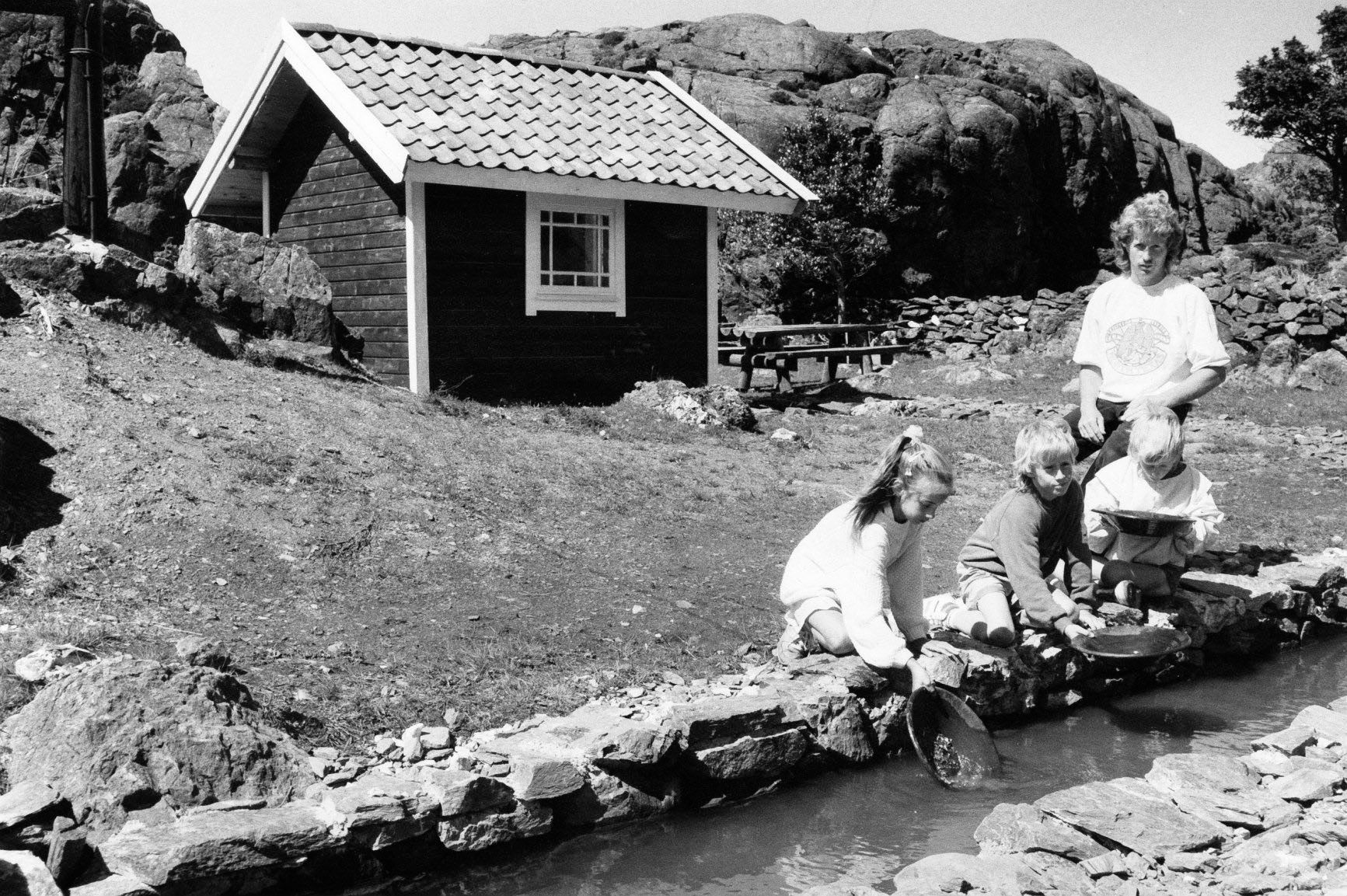
My father has developed the farm to this day together with my mother Marit Johanne who comes from Jæren. With inspiration from the golden age at Lykling, they built the gold panning camp on the farm in the late 1980s and early 1990s. This is located by the Harald Haarfagre path.
My parents have had three sons during their time on the farm. As the youngest son and sixth generation on the farm, I will take over the operation and exciting development of Gullvegen Gardstun.
Together with my partner Runa, I want to pass on family tradition, history and culture, and create a place for everyone. Here we will continue the exciting journey and create a great chapter in the book about our family here at Gullvegen Gardstun!